Showing posts with label Born to Ride. Show all posts

Wednesday, November 28, 2018

ProRider Atlanta- The Ultimate Rider Course


It is widely understood and acknowledged that motorcycle police officers are among the best trained and most proficient riders on the planet, in any country. The extensive and strenuous street training they undergo challenges the limits of man and machine. Very few police officers undertake the vigorous course. Fewer still successfully complete it. Yet those who do possess a skill level in riding virtually unknown to the rest of the motorcycling world.
Ken Anderson is one of those elite riders. With over 30 years experience as a motorcycle officer, including hundreds of hours of intensive training on multiple levels, and a seasoned police instructor himself, Ken has now brought this training to the civilian motorcyclist. ProRider Atlanta takes main skills taught and drilled into motorcycle officers and translates these into civilian format, to benefit the wider rider world.


I had the opportunity to participate in Ken’s ProRider class back in October, and the 8-hour course was one of the most challenging and rewarding I’ve ever undertaken. I took the course on my 1998 Yamaha Royal Star, since it’s equipped with front and rear highway bars in the event of a drop (which didn’t happen, I’m proud to say). I’ve always been very confident on the big Yamaha, having logged nearly 16 years and 90,000 miles on it. By the end of the day, I would come to realize how much more I and my bike are truly capable of.
Led by Ken and aided by Ken’s wife Patty, we were coached through riding tasks as basic as the proper way motor officers mount and dismount their bikes (from the right side, never the traffic side), how to correctly lift a dropped bike, and the safety reasons for always staying in gear while at stop lights. Ken taught then demonstrated proper clutch/throttle modulation, with Ken asserting, “The power of your motorcycle is not in the throttle, it’s in the clutch. You can twist the throttle all day, but the bike won’t roll forward until you release the clutch.” So, learning your clutch’s “friction zone” and how to manage your throttle and rear brake in unison with it, is key to improving slow control riding, obstacle avoidance, and negotiating tight cornering without resorting to “duck walking” your bike through parking lots.


We worked on the skills of clutch/throttle/rear brake management all day through a series of increasingly difficult cone courses, from simple cone weaving, quick lane change, deep & wide corner negotiating, and performing a complete “360” within a tight circle of cones. As we drilled these over and over, Ken would stop and give individual observations and instruction, as well as group debriefs before moving on to the next exercise. We didn’t master the techniques fully in one day (moto cops take months, even years to master the skills), but we each dramatically improved as the day progressed.

Ken also taught essential skills such as braking in curves, keeping eyes up and looking where you want to go, “not at your front wheel” as he calls it, and rear crash avoidance. We ended the day with a nerve-wracking exercise in emergency braking and escape, as in hard front/rear braking that results in a controlled tire skid and stop. We practiced this from 20 mph, then 30, then 40 mph, seeing the evidence of stopping distance in our skid marks. My Yamaha is not equipped with ABS or Traction Control like most other class participants, but I found I could stop in every bit the same distance they did after numerous runs, and wasn’t intimidated by my screeching tires as I came to a straight, controlled stop. Wow, and whew!

By the end of the day, Ken and Patty awarded each of us an official ProRider certificate of successful completion, which my insurance company has promised to honor with some discounts. Nice.
In all, this class pushed me beyond what I thought my limits were. I saw how much more riding control I am capable of, and how much more my bike is capable of as well. My confidence in my riding skills certainly has notched up a level.
*Oh, cool feature of Ken’s class- you can return to keep practicing the skills with subsequent classes, free of charge, for up to one year (subject to space availability in the class).
I highly recommend Ken’s ProRider Atlanta motorcycle course. Every rider should seek to improve their street skills. In my experience, there simply is no better instructor than a seasoned motorcycle officer. And Ken is the best of the best.


*For more info on ProRider Atlanta, click here- www.prorideratlanta.com
*Check out their Facebook page-
https://www.facebook.com/prorideratlanta/

*Photos by Phil Gauthier

Friday, November 02, 2018

Time Passages


Last month, my father did the unthinkable-he sold his motorcycle. It was a 2003 100-Year Anniversary Edition Harley-Davidson Heritage Softail Classic. Beautiful bike, and he took immaculate care of it. Best of all, he rode the heck out of it, often with my mother riding pillion. So to see it go was hard, to say the least. But it was time. He’d been struggling with ill health in recent years, especially 2018, and turned 79 years old over the summer. He quipped, “The older I’m getting, the heavier this bike is getting.” He asked me to help him sell it, and it went to a good home- a former H-D mechanic, getting back into riding, who has a great affection for Heritages. Very appropriate.
I was saddened myself, because not only was this the passing of an era for Mom and Dad, it was a sort of “time passage” for me as well. We had pounded out many roads and road trips together over the past 13 years or so, logged many miles, made many memories. Precious few, even in motorcycling, can say they’ve ridden much with their fathers (or mothers), but I can, and I’m thankful.

 Dad grew up riding motorcycles, back in the 1950s. He owned a stripped/bobbed 1954 Triumph Tiger 500, and was the hooligan of West Roxbury, Massachusetts on it. He street raced, blasted through town with the baffles out, rode with a pack of rascals, preened on it for the gawking pretty girls, but kept his heart for one- My mom.
When Pop left for the Air Force, he sold the Triumph to a friend, who apparently wrapped it around a tree outside town, barely living to tell the tale. No pictures remain of the bike. Pop rode Cushmans while spending a year on Okinawa, then returned home to marry my mom, settle into a career in the airline industry, and raise three crazy, “wild at heart” boys down in “God’s Country” here in the South. He left motorcycles behind for many years, even while supplying us kids with trail and dirt bikes.
I took up street riding in 1996, and by 2005 Pop caught the bug again too. We fixed up a 1982 Yamaha 550 together, and after test riding it some, Dad decided to jump back in, this time on a Harley. First buying a 2006 Super Glide, then swapping for the Heritage (more comfortable for Mom), they both went all-in, decking out in all the best H-D gear, adding a bike trailer and toy hauler to the collection also.

 We rode all over the southeast together, and many of the famous routes down here- the Tail of the Dragon, Cherohala Skyway, and Blue Ridge Parkway, to name a few. I’ve cherished every mile, every hour, riding with him across these years. He’s already experiencing “seller’s regret” understandably, grieving the steady passing of time, cursing the relentless marching of age. But it was time, they both acknowledge.
I guess I’m grieving too, selfishly, knowing our days of riding together are over. But I’m grateful to have ridden with them these years, and grateful my girls have inherited a love for riding, by the times they've shared with me on my bikes.
The guy who bought Dad's Harley? He told me how excited he is to take his wife riding with him, and hopes his daughters will fall in love with riding as well, on the back of that Heritage. As the saying goes- “One man’s sunset is another man’s dawn.”
Oh, Mom and Dad are talking about buying a golf cart now. A gas-powered one. With the big, knobby tires. Maybe raised white lettering. And an engine he can tinker with- maybe squeeze a few more horses out of? This could get interesting....

Monday, September 03, 2018

Motus Motorcycles Closes Doors


 The most unforgettable bike I have ever ridden.
In a move that saw another American motorcycle company go under, Motus Motorcycles in Birmingham, Alabama announced their closure via Facebook over the Labor Day weekend. The announcement stated the company “is forced to shut down operations, effective immediately.”

The vision of building the ultimate American sport-touring motorcycle was birthed in the minds and hearts of Lee Conn and Brian Case 10 years ago, and Motus was born. The uniquely American notion of building a bike around essentially half a Corvette engine (their vaunted “Baby Block” MV4 1650) captured the imagination of the American motorcycling world, if not their wallets- the standard MST and sport MSTR fetching a rather whopping $30K-$36K, respectively.
The issue for any fledgling motorcycle brand is always cash to keep going and growing. Conn and Case wrote Friday, “This week, Motus financial backers unexpectedly informed management that they will not provide sufficient capital to maintain operations and grow the business.” After thanking their “Team Motus” for dedicating “so much of their hearts and souls to Motus”, the statement declared the founders “will work to quickly find a new path forward.”
Motus joins a litany of downed American brands in recent years, including Victory, Buell, and Brammo, among others. We at Born to Ride certainly hope Conn and Case can reopen the doors of Motus in the not-too-distant future.

Tuesday, August 28, 2018

PittRace Crazy for MotoAmerica


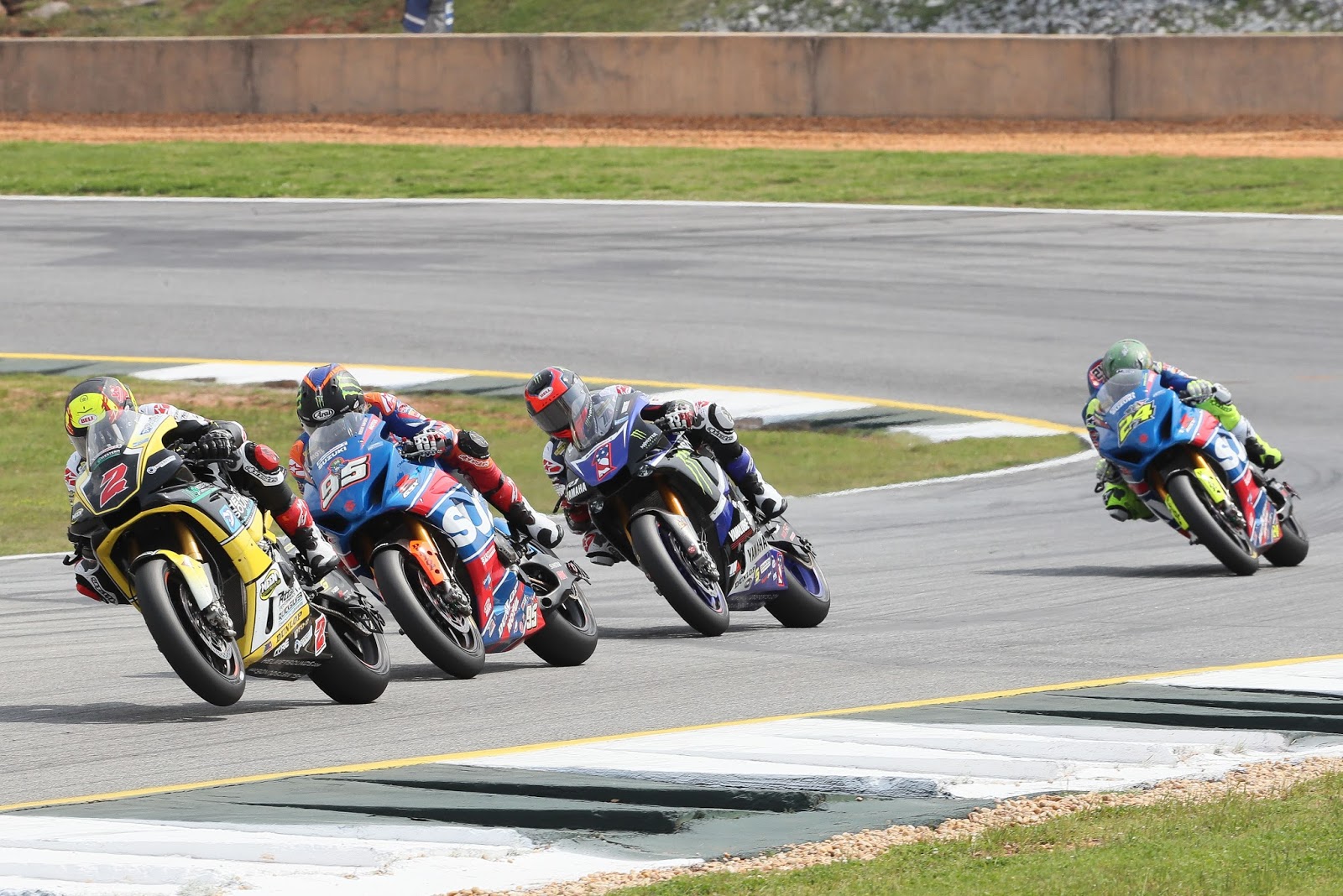
The racing was chaotic and crazy at Pittsburgh International Speedway this weekend, with crashes, red flags, and photo-finishes characterizing the championship series in all classes.
Saturday saw questionable conditions on the track due to adverse weather, and when the racing got underway, all bets were off as to who could master the track. In Superbike, Georgia’s own Josh Herrin battled to the front, and held the lead to the checkered against the Texan Garrett Gerloff and South African Mathew Scholtz. This was Herrin’s first win in five years, and the 2013 AMA Superbike champ commented, “I was on the podium when I suddenly realized this was my first Superbike win in five years! That’s a huge deal for me. I just put my head down and went for it.” Points leader Cameron Beaubier and 2017 champ Toni Elias struggled in the wet-to-dry track conditions, coming up 5th and 4th, respectively.

 In Supersport, Frenchman Valentin Debise snatched the Saturday win from Hayden Gillim and Bryce Prince, while class leader JD Beach struggled in the changing conditions, and finished an uncharacteristic 4th, one of the few times he is ever off the podium.
French Canadian and current points leader Alex Dumas took his seventh win of the season in Junior Cup, in a chaotic race that was red-flagged twice due to crashes.
The Twins Cup race was mastered by Jason Madama, taking his third podium of the season, in a near photo-finish run to the flag. Twins had also seen a series of crashes, with a red flag restart as well.
What a day.

 Sunday saw the return of an epic last-lap battle between protagonists Toni Elias and Cameron Beaubier, as the two swapped the lead and some paint until the checkered flag. Elias squeaked out the win by a mere .046 of a second over Beaubier, another definite photo-finish. Elias dedicated his win to the late Brian Drebber, beloved MotoAmerica race announcer, who died tragically on Thursday in a motorcycle accident, on his way to catch a flight to PittRace for the weekend.
JD Beach jumped back to the top of the podium Sunday in Supersport, in yet another red-flag shortened race for the weekend. With a 98-point lead over Hayden Gillim, Valentin Debise, and the rest of the field, and two race rounds to go, Beach looks to sew up the championship at New Jersey September 7-9. After the win, Beach quipped, “I’m not too sure that would have happened if we would have gone the full race distance, but sometimes it’s better to be lucky than good.”
Alex Dumas did the double in Junior Cup, after battling Renzo Ferreira until Ferreira crashed out of the race, as did Ashton Yates. Young Dumas holds a 64-point lead in the 300-400cc championship standings.

 Stock 1000 ran on Sunday, and Andrew Lee took his second win of the season, after claiming victory at Sonoma. Again, the class saw red-flags flying, and Lee took the win in yet another shortened sprint to the finish.
Whew, what a wild weekend. Stay tuned for more info on the two remaining rounds, New Jersey and Barber, and make plans now to join Born to Ride at Barber Motorsports Park for the climactic final round of the 2018 season, September 21-23.
Tickets- MotoAmerica.com
Race highlights- BeIN Sports USA on Youtube
Race reports- BorntoRide.com

Rob Brooks
 

Monday, August 06, 2018

My Brother's Keeper

 
Recently I was riding back through middle Georgia lake country following a couple of days spent with my parents. After a fuel stop in Bostwick, an old cotton town, I suited and saddled back up to continue my journey home. A lady rider about my age had pulled in not long after me, and now was having difficulty firing back up her old Harley Sportster. Our eyes met, and I could see the look of "can you help me?" in her eyes. Without hesitation, I removed my gear, retrieved my tool kit, and went to her aid. The problem fortunately was minor, a battery post that needed to be scrubbed of corrosion and tightened down. A warm thank you, a grateful handshake, and she was on her way, as was I.

Motorcyclists have some unwritten codes, which we all (mostly) abide by, such as "the wave", riding staggered with each other, among others. Notably, most motorcyclists also follow the rule, "never leave a fellow rider stranded." This is regardless of brand or type of bike. I've been on the giving and receiving end of this "biker good will", and it's one of the many reasons I love the motorcycling community.

A couple of months ago, I was driving my pickup home from working up town, when I witnessed a young sport bike rider on the opposite shoulder, struggling with something at his rear wheel. I whipped around as soon as I safely could, and came to his aid. Turned out, his chain master link had broken by his rear sprocket, and for nearly 40 minutes he had been trying to fashion a snap of some kind to get him home. "No one has stopped or even slowed down to offer any help, not even to make a call for me," he lamented. I lived about 5 miles away and had a motorcycle trailer, I told him, and offered to transport him and his bike to his house, which turned out to be only a few miles away as well. I sped home, hooked up the trailer, grabbed a box of straps, and returned to load man and machine. Upon off-loading the bike at his place, he offered to pay me for my "troubles", which I respectfully declined. "It's what we do", I told him.

To be sure, there are some elements within motorcycling that refuse to acknowledge or come to the aid of fellow riders. Adherents of certain brands, certain types of bikes, and certain club riders look down upon any not like them, and refuse to assist those not of their ilk. And yet, they are a minuscule percentage of the motorcycling world, a fringe not representative of the vast majority of us. Overall, across the years and miles, I have found members of the motorcycling community to be among the most caring, helpful, and selfless people I have ever had the privilege of knowing. And I'm proud to be counted among them.

A couple of years ago, while on a long, multi-day road trip, a friend of mine found himself on a highway shoulder, sidelined by a large screw in his rear tire. While trying to remove the invader so he could insert a plug from a tire repair kit he (wisely) carried, he suddenly found himself surrounded by a group of patched club bikers, who had pulled over and parked in front, behind, and even street side around him. "Oh crap," he thought to himself, being on a metric cruiser, and traveling alone. His concerns were quickly dispelled, however, when the leader asked, "Any way we can give you a hand?" These rugged riders assisted my friend get plugged and reinflated, then accompanied him back into town to a local bike shop, for a better examination of the tire. When my friend offered to buy them all dinner for their troubles, they graciously declined, but each shook his hand, wished him luck, and were on their way. "Just glad we could help" was their response.

Motorcyclists tend to get painted with only a few brush strokes, by the media and the general public. We are often portrayed as scary, hard-core biker gang members, as "Sons of Anarchy" types, or as reckless, inconsiderate "stunters" and "squids", endangering ourselves and others around us. Granted, there are far too many of those among us. But again, these do not represent the vast majority of riders, anymore than a few "quacks" in the medical field represent the vast majority of knowledgeable, conscientious, hard-working physicians.
The late singer-songwriter, Rich Mullins, once penned a song that, though not specifically about the motorcycling community, most certainly applies to how many of us view each other-

I will be my brother's keeper, not the one who judges him.
I won't despise him for his weakness; I won't regard him for his strength.
I won't take away his freedom; I will help him learn to stand.
And I will, I will be my brother's keeper.
-Rich Mullins, "Brother's Keeper"

I frequently ride with a widely diverse chapter of the Christian Motorcyclists Association, called the Kneebenders, made up of all kinds of bikes, all kinds of riders. We include sport bike riders, cruisers, tourers, a couple of ADV riders, and several Harley riders. We are "red and yellow, black and white" like the old children's Bible song. We have men and women riders, and we run the gamut of socio-economic status. We even come from the four corners of these United States. Despite all this, we share two commonalities- we are all Christian, and we are all riders. We are devoted to honoring "the code", among any and all we might encounter.
With all the divisiveness in the world today, even in our own culture, as riders we have the opportunity to make a positive impact by how we treat each other, and how we extend a helping hand to those around us. Let's endeavor to be "our brother's keeper", and model togetherness and generousity to a divided world.


Sunday, April 08, 2018

MotoAmerica Preseason Observations


Spring is here, and racing is in the air.
MotoAmerica, the nation’s premier motorcycle road racing organization, returns for its 4th season. Helmed by racing legend Wayne Rainey, 3-time World Gran Prix champion, MotoAmerica is returning the sport to its former glory days of the 1960s-1990s. With race weekends spanning the country (3 of which run here in the South), the season kicks off at Road Atlanta with great fanfare, including exhibitions by Tony Hawk & Friends, the infamous American Motor Drome Company “Wall of Death”, a Kid’s Zone and the “Caffeine & Kickstands” custom bike show.
I talked with Paul Carruthers recently, MotoAmerica’s Communications Manager, about the 2018 season-

Rob- 2017 was such a thrilling season: The epic battles between Toni Elias, 2016 defending champion Cameron Beaubier, Roger Hayden, and veteran Josh Hayes; Toni taking the Superbike title in the end; Garrett Gerloff winning his 2nd consecutive Supersport title, etc. After watching the preseason testing, who’s looking strong to threaten for the titles this year?
Paul- The preseason has been a good one, and has shown just how close we expect the racing to be in the Motul Superbike class. Cameron Beaubier has been impressive in coming back from injury to lead all the tests and you can tell that he's full of confidence and wants that number one plate back! We all know now how strong Toni Elias can be, so counting him out would be silly talk. There's also a lot of fast young guys jumping up to Superbike this year, riders like Mathew Scholtz and Garrett Gerloff.
Rob- There’s been some realignment of the classes this year, and the introduction of Super Twins, which I think will be thrilling to watch- definitely to hear!
Paul- We think the Twins class has a good future. It's normally a big class in club racing and we think we'll see a lot of local guys showing up to race. It's an interesting class, and we might see a lot of different things out there on the track. Should be fun to watch and, as you say, listen to!
Rob- What can fans expect to see in the racing this year?
Paul- They will see great racing in every class. The Junior Cup will be loaded with talented kids this year, now that it's open to all the manufacturers. Superbike will be a thriller at every round and Supersport will be closer than most people think.
Rob- What can fans expect to experience at a MotoAmerica event this year?

Paul- We are making a big push to make our events truly “events”. While our focus will always be the racing, we are ramping up the other activities so that our fans will have plenty to do every single day at our races. At Road Atlanta, for example, we're having Tony Hawk and his team come in to give the fans skateboarding exhibitions on a giant ramp that will be in the paddock. (Road Atlanta round will also feature the "Wall of Death") We will have musical acts at most of the events, so I think people will be impressed with MotoAmerica in 2018.
Rob- beIN Sports network will be carrying all the races this season, right?
Paul- Between beIN Sports and beIN Connect, all of our races will get live coverage. It might switch around as to what races are on what platform, but they will all be covered.
Rob- Road racing has a long history here in the States. What do you see as its future? A return to the glory days of the 60s-90s?
Paul- It's a different time, but we’ll get it to where it needs to be. We want competitive racing, a chance for our riders to race internationally and we want to provide events that our fans can enjoy from morning ‘till night.

Rob- Can viewers also find and follow the action on MotoAmerica’s website?
Paul- Yes, we’ll have timing and scoring on the site from every event so people at home can follow the action. We are also packing the site with quality content about our series, our teams and our riders with both the written word and video content.
Rob- Born to Ride will be there, covering the Southeastern rounds, and running regular updates on the standings as the racing progresses. It’s going to be an exciting season.
Paul- As always, we look forward to seeing you guys there, and we can't wait to get started!
Don’t miss the speed and roar of American motorcycle road racing- Visit MotoAmerica.com for tickets to every championship weekend, and catch the races on beIN Sports and beIN Connect all season.

Wednesday, January 31, 2018

Sound & Fury- The Ballad of Ricky Patterson


Since a motor was first paired with a set of wheels and handlebars, riders have felt compelled to race. Down dirt country roads, hard-packed sandy beaches, on board track ovals and race circuits, and especially drag strips, the thrill of top-end speed has always held a firm grip on motorcycling. With the resurgence of American road and flat track racing, renewed attention has returned to motorcycle drag racing, arguably among the oldest forms of motorcycle racing.

For a recent evaluation article I wrote on the Triumph Street Triple R (Dec. 2017 Born to Ride), we borrowed a bike from Freewheeling Powersports. Imagine my surprise when entering general manager Ricky Patterson’s office, to find trophies, photos, and memorabilia adorning the place, testifying to Ricky’s motorcycle drag racing years! I had to dialogue with him about it, fascinated by this soft-spoken, gentle giant of a man with a slow Southern drawl, who spent years roaring down a drag strip in excess of 100mph on motorcycles.

Mainly running local motorcycle bracket racing, Ricky started racing back in 1985 while working at a dealership. As Ricky tells it, “A guy came by the dealership with a drag bike on the back of his truck, and I thought, ‘Man, that is so cool!’. He invited me to a race night nearby, and I was hooked.” At the time, Ricky owned a 1982 Honda CB750, so he took it to Paradise Drag Strip in Calhoun one Sunday, entered in the ET open bracket, and ended up winning. Ricky reflects, “I kept going back, realized I was pretty good at it, and really enjoyed it. I kept progressing, moving up to larger dedicated drag bikes, racing every Saturday and Sunday. I couldn’t get enough of it.”
The main track Ricky ran was the Southeastern Dragway in Dallas, Georgia, an NHRA sanctioned strip. A typical racing season ran from March to October, and competitors in the top 10 points standings were invited to the NHRA Bracket Finals, running against racers from across the Southeast. In 1993, Ricky won the track championship at Southeastern Dragway, moving on to the NHRA Bracket Finals in Atlanta. Ricky took 2nd place in the “Race of Champions”, a competition of the points winners from all the regional tracks. “That was a huge thrill for me”, Ricky recalls.

And then, Ricky won the coveted “Wally”, an NHRA National event trophy. The Wally is only won at national events, either by winning in Pro Stock or in Bracket Finals. In 2005, National Dragstrip, NHRA’s official publication, sponsored a grass-roots level, bracket racing series of events, awarding the winners a Wally. “I had stopped racing by 2000,” Ricky shares, “and the Dallas strip was closing up. That was going to be Dallas’ last race, and they were putting a Wally up for winning. I didn’t have a bike, but a buddy of mine loaned me one. I arrived too late to get in a couple of practice runs and times.” Ricky advanced up through his bracket, winning runs across the evening. Inclement weather threatened the rest of the weekend, so at 4:45am (yes, you read that right), amidst Pro Stock, Funny Car, and other category finals, Ricky won his final run, taking home the prized Wally trophy, in the last race at the legendary Dallas Southeastern Dragway. “I’ll always treasure that, always be grateful to the friend who made it possible,” Ricky declares. “We went out and celebrated with breakfast at a local Waffle House.” Of course!

With a racing career spanning 20 years, Ricky names the Gainesville, Florida ¼ Mile and Atlanta Dragway as among his favorites. “We ran a lot of AMA Pro Star events, went on that national circuit, all ¼ mile tracks.” Ricky recalls a weekend he broke a crank in the final round at Dallas, losing the race, drove home, pulled the motor and replaced the crank, drove to Calhoun, and won the race on Sunday. “On no sleep, I might add,” Ricky chuckles.

After literally thousands of runs across two decades, Ricky hung up the leathers after the Wally win in 2005. “Motorcycle drag racing was a little different than other forms of motorcycle racing,” Ricky says. “You didn’t have to spend a lot of money to be competitive in bracket racing, and there were strips all over the South.”

Ricky is the co-owner/general manager of Freewheeling Powersports in Douglasville, Georgia, along with his business partner and long-time friend, John Feckoury. These pals go back to 1985, when John hired a young 16 year old Ricky at Honda of Cartersville, only to be reunited decades later when they went in together to buy Freewheeling, itself a Triumph, Honda, and Suzuki dealership. The establishment is one of the oldest Triumph dealers in the nation, and one of the most decorated and respected by Triumph North America. Ricky’s racing legacy only adds to the mystique here.
When in North Georgia, east of Atlanta, stop by Freewheeling Powersports. Browse the bikes, talk with the great staff, and look up Ricky, whose office is back in the Triumph section. His easy-going, laid-back friendliness belies a great love of motorcycles and racing, of sound and fury.

Monday, January 01, 2018

2017- A Look Back

 
2017 was an eventful year in American motorcycling. Reflecting over the previous 12 months, clearly much has transpired in the two-wheeled world. Its been both exciting and discouraging. There were a great many stories from 2017 in motorcycling, but these are a few of the ones I most readily remember-

The Demise of Victory Motorcycles- After 17 years, Polaris scuttled the Victory line, a JD Power & Associates quality-leading motorcycle brand. The move shocked the industry, and those of us in moto-journalism. The move was understandable, with Polaris planning to focus greater efforts on the highly successful Indian line, but I was stunned, nonetheless.
*Oh, and within weeks, Erik Buell Racing shut down operations...again.

The Death of Nicky Hayden- One of America's great motorcycle racers, Nicky was beloved the world over, not just here in the States. The "Kentucky Kid" was an AMA Flat Track champion, AMA SuperBike champ, and 2006 MotoGP World Champion. His cycling accident and sudden death in Rimini, Italy horrified the motorcycling world, as millions grieved his passing. I personally sat and wept at the news. Nicky will be sorely missed.

Harley Davidson's Sweeping Changes- Late summer, H-D announced and debuted radical changes in their lineup, dropping the venerable Dyna line completely after 27 years. The all-new Softail line saw several Dyna models redesigned and dovetailed in, as well as some brand new models- most notably, the Fat Bob, all with the new "Milwaukee Eight" powerplant. I had opportunity to ride a couple of them, the Heritage and Road King, and was very impressed.

American Flat Track & MotoAmerica- AFT exploded in popularity in its first year away from the AMA, and MotoAmerica dramatically expanded its reach in its 4th season. I'm very glad both are back, and I hope these signal a revival of interest in American motorcycle racing.
*Interesting note- the most talked-about American motorcycle of 2017 wasn't even a production bike- the Indian FTR1200, a factory-modified Scout based on their highly successful (and AFT-winning) flat track racer.

The Revival of Retro- All the major brands have trotted out spectacular bikes combining modern amenities with retro (60s-80s era) styling. BMW's RnineT bikes, Triumph's entire Bonneville line, Honda's CBR1000R Blade, Yamaha's XSR900, Kawasaki's Z900, Ducati's Scrambler line,...I could go on. Us old guys love the nod to the bikes we grew up riding and loving, and the younger crowd clearly revels in the nostalgia these bikes recall. Its a great time to be riding!

With all the concern over the flagging bike sales in America, and companies seeking new riders among the younger generation, 2017 was a year of reassessment in the industry. These are but a few of the events and developments of the past year, the ones I most remember. I hope 2018 will see even more in the way of good news.

Wednesday, December 27, 2017

The Little Men

Motorcycling's Small Business Owners


(Melton's Trike & Cycle Works)
I recently needed a rear tire on my big Royal Star, and planned on taking it to a local Yamaha dealership I’ve used before. I happened upon a small privately owned shop behind a trophy store, called Melton’s Trike & Cycle Works, and dropped in to check it out. Turned out, David Melton, the “proprietor”, has been receiving our magazine for several months now, and I enjoyed a brief conversation with him. I decided to bring my bike to David, and let him do my tire mount and balance. He installed it while I waited, chatting me up all the while, and at a price better than the local dealership would have done. I’ve been recommending Melton’s Trike & Cycle Works to my riding friends ever since.

(David's shop)
I also picked up an old project bike to restore, a 1986 Yamaha Radian 600, which had sat in the back of a machine shop collecting dust and rust for over 12 years. The tank was among the worst I’d ever seen, full of caked-in rust and corrosion. Upon discovering Craig Skiver’s “Craig Paints Tanks” ad in our mag, I shipped it off to him, to see what he could do that local radiator shops could not. He promised a three-day turnaround from reception, and sure enough, within days, I got an email from Craig declaring the tank complete and on its way back to me. When I unpacked it, I was astounded at the job he’d done. The tank looked nearly new inside, scoured clean and shiny again, with a thick aircraft tank-grade clear coat throughout. Craig has my tank (and paint) work from now on. See my article in this month’s Born to Ride Southeast edition- www.borntoride.com

(Craig's handiwork)
While the large dealerships have so much to offer, not only in bikes, but in apparel, accessories, parts, and great service, I admire and applaud the small shops, the family and individually owned establishments, for their passion, dedication, and personalized attention to detail. The big enterprises get all the attention, but these “Little Men” as Alan Jackson once immortalized in song, are in many respects the backbone of American motorcycling, and certainly of our national economy. My father still rides at 78, and carries his ’03 H-D Heritage to a small one-man shop in Sparta, Georgia, owned by Mike, a retired H-D mechanic, when he needs service or parts. They’ve become friends, and Pops completely trusts his bike to Mike. “I’ll never take my Harley to anyone but Mike,” Pops declares.

With the American economy rebounding, unemployment dropping, and wages inching back up, optimism is returning for many of America’s small business owners. The motorcycle industry has suffered in recent years as well, yet hope abounds for the future of our sport, our passion. The older generation of riders is passing on the love of motorcycles to a new generation, and they are already shaping the future of motorcycling (see my article on Brother Moto, September BTR Southeast edition). This is especially good for the “privateers”, the small shops like David Melton’s and Craig Skiver’s, and the countless other repair, paint, custom, and restoration shops dotting our great land. I have many friends at large, established brand dealerships, and everyone I know at these are passionate motorcycle enthusiasts themselves. But the private “mom & pop shops” hold a special place in my heart, and I plan to encourage and support them with my business whenever I can. My grandfather ran a garage in Boston, Mass. throughout the 30s-60s, wrenching on everything from early motorcycles to boat motors to automobiles and diesels. I guess it’s in my blood, however unskilled I personally I might be with a wrench.
So here’s a shout-out and salute to “The Little Men”, those small business owners, the backbone, heart and soul of American motorcycling. May you grow and prosper in 2018.

Wednesday, November 29, 2017

Wayne Rainey- Anatomy of a Legend (full interview transcript)

Here is the full, unabridged transcript of my conversation with Wayne Rainey, with additional photos.


Debate often arises in motorsports over the definition of a legend, and what constitutes legendary status. Is it the number of wins across a career? National and/or world titles? Is it philanthropic work, contributions to the sport and industry? Overcoming tragedy or adversity? Perhaps it's personal honor, integrity, influence? By any definition-
Wayne Rainey is a legend.
In the span of a decade, Rainey amassed a resume of wins and titles that would cement his status as an icon of motorcycle road racing. He won the AMA National Championship in 1983 and 1987, and claimed the coveted Daytona 200 title in '87 as well. Rainey moved onto the world stage, capturing the renowned Suzuka 8-Hours endurance race with teammate Kevin Magee in 1988. Rainey then dominated the GP World Championship for three years, sweeping the 500cc premier class from 1990-92. A career-ending and life-altering injury changed everything in 1993, resulting in permanent paralysis from the chest down.
But Wayne Rainey didn't stay down.
He reinvented himself for the rest of his journey, managing AMA and GP teams, participating in SuperKart racing, and ultimately birthing the dream that would become MotoAmerica.
I had opportunity to sit down with Wayne for a few minutes, at the final round of the 2017 MotoAmerica season at Barber Motorsports Park in Birmingham, Alabama. What ensued became a candid, insightful conversation, revealing something of the heart and soul of the man.

RB- I remember following your racing career back in the day. The Suzuka 8-Hours was impressive! Very few people even know what that is.
WR- It's a bad-@$$ race, for sure! I was racing Gran Prix's that year, running at the highest level in motorcycle racing, then went and did the Suzuka, and realized I was NOT at the highest level! The Japanese take that race, and only that race, as the number one race they all want to win, and Gran Prix second. It was so exciting to win that.
RB- I can't even imagine! At what age were you first introduced to motorcycles? How did you ever catch the riding/racing bug?
WR- My father got into soapbox derby, go-cart racing, and then motorcycles. He had a 90cc Yamaha in the mid-60s, and was a tinkerer as well as a rider. I was about 6 years old when I first started riding, on a little Honda Cub. The Cub was kind of tall for a 6-year old, so my dad put a seat right where the fuel tank meets that under bone. Handlebars above me, seat hitting my back, and I was sitting down in it! First time I ever rode it, we were in the garage, and he said, "Keep your foot on the shifter, give it a little gas, and let off the shifter." I wheelied that thing right into his cabinets! Needless to say, I was a little intimidated, running out of the garage crying! I came back though.
RB- Indeed you did. When did you first start competing?
WR- I started racing at the age of 9. In Southern California, we had ten different race tracks, and could race seven days a week. A definite hotbed of dirt track racing. We lived 10 miles from Ascot Park, and my dad built bikes to race the Ascot Half-Mile. I'd go with him every Friday night as a young lad, and learned all the riders by name, their numbers, everything about them. I ate, slept, and drank the racing. When I was old enough, I finally got to go do it myself.

 RB- You really cut your teeth in flat track.
WR- Yeah, I didn't do my first road race until 1980, when I was 20 years old. Never even been on a track before then.
RB- What attracted you to road racing?
WR- I was dirt tracking and Kawasaki wanted to sell KX250 engines to dirt trackers. They contacted me, a “So Cal” kid. They had approached Eddie Lawson, asking "Who do you see that we could develop that motor with?" Eddie recommended me, so they reached out to me- "We got this engine, we'd like to build a short track chassis out of it. Will you run it? We'll buy your tires, pay your gas,..." and I quickly said, "You got a deal!" So we went out and had some success with it, and they soon asked, "Have you ever considered road racing?" I had not, never really been interested in it aside from reading about it in the magazines, so they sent me to the Keith Code's California Superbike School. I went through the training, progressed pretty quick, and they asked if I wanted to try a race. So I tried it. I ended up winning 15 of my 16 races! They later contacted me again, saying, "There's an AMA National race in Loudon, New Hampshire. If you can be there in three days, we’ll have a bike there waiting for you." I was going to race in my first pro 250 novice class. A buddy and I drove cross country to the race, still with my dirt track leathers and gear. It rained during the race, and I had never ridden the bike, never ridden on this track, never ridden in the rain, and we won the race by 20 seconds! Next day, Kawasaki showed up at the race track with a contract to race Superbikes for them the next two years.

 RB- Do you think your flat track racing experience gave you an edge in any way, when you transitioned to road racing?
WR- I think so, and it helped Kenny Roberts before me. Freddie Spencer did it that way too. All the American world champions had a flat track background. The 500cc GP bikes were wicked machines. It took a special style to adapt to them. The Europeans are doing it now, but they weren't back then. Rossi, Marquez, all those guys, work off-season on dirt track, but we were doing it decades ago. So I'd say it was an easy transition, easy translation of skills. The natural dirt trackers were always the Americans.
RB- I remember when the grids and the podiums were filled with Americans.
WR- We didn't know how good we had it, did we? Whole front rows would be Americans, podiums would be all Americans,... Now, there's no one in the world championships, in MotoGP. There's P.J. Jacobsen running well in World Supersport, but sadly, with Nicky's passing, P.J. is it, on the world stage. We hope to change that.
RB- There's been a lot made of your rivalry with Kevin Schwantz. How did that develop? Did something happen, or was it just two fierce competitors battling it out across the years for dominance?
WR- Yeah, by that time I guess I was kind of an established guy. Schwantz came along, with a lot of natural talent, and I saw he was going to do whatever it took to beat me. He really raised my game, because I didn't want him to beat me. We raced each other really hard, much harder than the other guys. I guess we didn't like each other, because we didn't like how we were treating each other on the track! We were both determined to beat the other. I like to think I got the best of Kevin every single year, but the rivalry certainly made us both better.
RB- But in the end, there can be only one.
WR- People win championships for all kinds of reasons. But the one thing that's always the same is, the guy with the most points at the end of the season, wins. I was a very consistent guy, was on the podium most of the time, and ultimately, consistency wins championships. And it wasn't just Kevin I was battling. There was Mick Doohan, Eddie Lawson, a lot of really huge names out there then. Exciting times for racing.
RB- You ran for Kenny Robert's teams a number of years, right?
WR- I ran for him '88-93, for six years. We had known each other, and I had started hanging out with him a bit, so he put a team together for me to race in Europe. I ran 250cc bikes my first year with him. Really didn't think I was ready for it, but we did it, and I got to see the future.
RB- Would you say you really peaked, really took off, under his tutelage? Did he help refine, tune your skills even more?
WR- Yeah, definitely! Kenny and I really clicked. He had plenty of riders under him who didn't have the success we had together. I think he saw in me someone who would do everything to get the most out of myself, my team, the machine, so he fostered that environment for me. A lot of my teammates came and went, but there's no doubt the friendship, relationship we had was special.

 RB- 1984 was a tough year though.
WR- Oh, yeah, I hated it that year, thought Kenny was a prick! We had to push-start the bikes, and often by the time we got started, I was like 20 seconds behind the pace car! So not only was I having to catch and pass the pace car, they usually had no idea some weenie was behind them! And I'd have to listen to him as I was push-starting the bike, yelling, "Push harder, you $!&?-head!" But he pushed me, for sure. Made me a better racer.
RB- It’s uncomfortable for me to bring up, but I watched footage of your fateful crash at Misano in '94. A major life change, in every way.
WR- Yes it was.
RB- How did you personally work through that, overcome it, and reinvent yourself?
WR- (pauses to reflect) That was 24 years ago, September 5. So it's not really that long ago, and yet 24 years is a long time. I'd probably now do a few things differently, but here was this 33 year old man, world champion, did everything on my own, then suddenly, I needed help going up a step, or grabbing a cup, or anything. The way you do everyday functions, how you get in and out of the car, or the bathroom and shower, the bed, everything changes. The first thing you see in the morning is that wheelchair, and the last thing you see at night is that wheelchair. So it's become my legs. You either adapt, or you die.
RB- Adapt or die- physically, mentally, emotionally, spiritually.
WR- It was a very tough time. It took a few years, a lot of mistakes, some deep pockets of grief, but you know, I have a strong faith in the Lord, and that pulled me through, that's what worked for me.
RB- You worked through it all, and your faith carried you.
WR- I had a 10 month old son at the time, and he only ever knew me in a chair, so I had to be strong for him, had to show him that his dad's going to be challenged, but everyone is challenged in their own way, every single day. You can whine about it, or pull your pants up like a big boy. It still could get worse too, I don't know. So I just live every day.

 RB- You've accomplished so much in the sport, on and off the track. What are your fondest memories, proudest achievements?
WR- I have so many memorable moments, and I'm still creating them. Obviously, being a very successful motorcycle racer, to have been able to make a career out of it. I loved racing motorcycles! I loved the competition, loved the challenge, loved racing at the highest level. I loved every win that I got, loved every 10th place that I got. I remember the battles, the rivalries. So I don't think any one particular thing sticks out more than others. I just try to be a decent dude, show courtesy to everyone I meet. Now, in my current situation, I try to pay attention to what some people have to go through when they're physically challenged. I'm sensitive to that.
RB- To me, what you've endured, where you are now, only adds to your mission.
WR- Every day we wake up, we have no idea what it holds, where it will take us. Nicky Hayden is a perfect example of that.

 RB- As I stated in my article about him after his death- life is fragile, life is fleeting, so live for a higher calling. You're still making a difference, in racing and beyond.
WR- I think you're right, only because I know what the outcome is now. I didn't when I was still racing. Won three world championships, on track to win a fourth. Where do you go from there? Some say the only place to go is down, but I didn't see it that way. I just wanted to keep winning as long as I could, and keep getting better. I was getting to the point where I wasn't going to accept anything but 1st.
RB- Looking at modern racers like Rossi, Marquez, Jonathan Rea- it doesn’t matter how many they’ve won, the next one is still a thrill.
WR- Rossi, he’s a special case. He came up through a different era than I did, but that hunger to win is still there with him. He obviously still has fun doing it.
RB- How was the dream for MotoAmerica born?
WR- My partners, Richard Varner and Terry Kargas, were building a motorcycle and through a mutual friend, asked if I would come help. I was pretty far away from the sport then, but that relationship started me back in the industry, calling my old contacts about parts. This bike had the look of a 1980s road race bike, but in actuality, it was a 2010 Yamaha R1. Back in the sport, I was getting a lot of questions- “What’s going on with American road racing?” I still had a relationship with Dorna (the international sanctioning body), so I started thinking, “There’s not many Americans; maybe I should start a young rider series.” There were only three U.S. Gran Prix races left, and one World Superbike race. My idea was, run a young spec class, and run it in the World Championship races held here in the States, Saturdays and Sundays of each, about an 8-race series. Joe Campbell from Laguna Seca asked me, “Why don’t you just fix the AMA racing?” Initially, we couldn’t get a deal with DMG, so I returned to my original idea of doing our own thing. That started gaining momentum and support, so pretty soon the DMG came back and said, “Hey, let’s talk about this again.” We worked a completely different deal the second time, so that’s basically how it all started. It took time to evolve, and it was never something I thought we could achieve, but I figured, unless you go all-in and try, you’ll never know. I had the right partners, for sure. Chuck Aksland from my Gran Prix days came onboard, joining Terry and Richard with me, and all these pieces came together at the right time. So now we are trying to make a go at it, revive American road racing.

 RB- Here at the end of your third season, how would you rate the progress?
WR- You know, from where we started, late in 2015, I think our skeptics are now fans! And some of the manufacturers, who thought we’d be gone after three races, see we are still here after three years. We began with live-streaming on Fans Choice, and now we have live TV with BeIn Sports. We have a good schedule, we have solid teams, and year 4 will see an all-Superbike class. We made changes this year to the Stock 1000 class that shows they can be very competitive. We have a team that the rider (Kyle Wyman) drives his truck to the race, engineers his own bike, and he almost won the race in New Jersey! If a guy can do that against the factory riders, we’ve done the right thing. So many of the Stock 1000 guys have run well this year- Hayden Gillim, Jason DeSalvo, Mathew Scholtz, all running up front with the factory guys. This next year, it’ll be an easier sell for them, that they will be Superbike teams, instead of Stock 1000.
RB- I’ve been watching the growth of MotoAmerica, parallel with the explosion of American Flat Track. They both seem to be feeding off the growing popularity of each other.
WR- Yeah, basically, dirt track and road racing are cousins. They’ve always been in the U.S. But they are run separately now, and actually are facing the same problems we have here. Indian is huge there, and they have the best riders, filling the podium at nearly every race, and here, we’ve got four factory bikes, and then you’ve got everybody else. So we are all trying to make it more marketable, so they all can go out and find sponsorships. We’ve had three years to try and stabilize our sport. We think we’re pretty stable now, and with the jump to Superbike, we’re going to now sell it to the fans.
RB- What do you see as the future of road racing in America?
WR- I hear racers say, “Oh, we’ll never get back to the level of the Europeans. They’re doing everything we did except they are starting at a younger age. They have more racers, better tracks, etc.” I say, give up that attitude! I tell you what, I’ve said, “Unless you think you can go over and beat those guys, they’re going to wax you, because you’re going to their house. We’re Americans. There’s a culture here they will never have. They don’t live here, didn’t grow up here.” As Americans, we automatically think we need to be better. I want our riders to believe that, to believe in themselves.
RB- That day is coming, I believe, soon.
WR- We’ll soon see the rider who believes in himself, has the natural speed, and the desire to go race in MotoGP, which means racing in Europe, at the highest level. We are trying to make MotoAmerica a competitive championship where, when a racer is ready to make that step, they’ll only have to learn the tracks and the bikes. They’ve already done the racing here.
RB- In the next year or two, what is MotoAmerica positioning itself to do to bring road racing back into the American consciousness?
WR- Honestly, we need guys like you that believe in what we’re doing, to help us build it up. We want to recapture the fans we lost, as well as go get new fans. It’s a new generation. It’s not, “win on Sunday, sell on Monday” anymore. We know we have to host an event, with a motorcycle race. A lot of things happening at the track- bands, fashion shows, bounce houses and activities for kids, vintage shows and races. People love seeing those old bikes, hearing them run around the track! We have to remember our past. That’s where we came from. We want to build the event, market that, invest in that. All of our investment has been into stabilizing. Now, we can start working on growing.
RB- I’m excited about the future of American road racing, glad you are at the helm of it. I’m not just a writer, I’m a fan.
WR- Well, we appreciate you coming out and supporting us. I hope every time you can come out, you see something new, something exciting.
RB- Your riders have a passion and competitiveness that draws fans. I saw that evidenced at the Road Atlanta round, when Beaubier (2016 champion) and Elias (now the 2017 champion) nearly came to blows in the press room following the race.
WR- Yeah! I want the championship to mean something. It’s got to be real. That was raw, real.
RB- Even the 600 Supersport class- I talked extensively with Garrett Gerloff (now the 2-time class champion), a young man of deep faith, humility, and integrity, and yet a fierce competitor on the track. To me, he well-represents the future of the sport here in America.
WR- Well said! If he goes up to Superbike, and starts to run with Elias, Hayden, Beaubier, I’m telling ya, he’ll fly out of this place. I told him, “Everybody is waiting to see who that next guy is going to be. Why can’t it be you?”
RB- I certainly agree. Thanks for your time, Wayne.
WR- My pleasure! Thanks for coming out!
American Road Racing is back. Check out MotoAmerica on the web, social media, and on BeIn Sports.
Rob with Wayne, Barber Motorsports Park, final round.
*All photos courtesy of MotoAmerica and the author.

Monday, September 04, 2017

2018 Harley Road King & Heritage

First Impressions

The quintessential American motorcycle company radically remodeled their Softail line recently, and shoehorned the Dyna line into it, introducing 8 all-new models. This, after debuting the brand new Milwaukee Eight 107ci last year in their touring line. With a new stiffer chassis, a monoshock suspension under the seat, and some models getting the bumped-up 114ci powerplant, fans of both the old Dynas and Softails should find much to love.
Harley-Davidson unveiled the new line Tuesday, August 22, and by Saturday, August 26, I was straddling one, blasting off into the central Alabama foothills, courtesy of our friends at Mt. Cheaha Harley-Davidson in Oxford. For comparison, I was also loaned a 2018 Road King, which had been among the models to receive the Milwaukee Eight 107 for 2017. It promised to be an abundantly fun day.

 
In the midst of Mt. Cheaha's 3rd Annual Rumble on the Loop, I first took off on the Road King, to sample the 107ci mill. Immediately, I was enthralled with this bike. Instant, head-snapping acceleration at the wrist-twist; thrilling, brutal power on tap up through each cog of the 6-speed gearbox. Granted, I ride a little more aggressively than some, being a sport as well as cruiser rider, so was a little heavy with the roll-on. But this bike delivers! Up through the hill country, the Road King dives into curves easily, brakes extremely well, shifts up/down solidly, and of course, that throttle! The bike felt like a comfortable touring cruiser with the heart of power cruiser.

 
Next, I took a spin on the newly remodeled Heritage, which actually wears the new 114ci motor. Thinking this bike would ride similar to the Road King, but with a power bump, I lit out hard like I had on the King. The Heritage quickly settled my raucous energy. Roll-on is more measured, spread out, and smoother. The 114 is clearly tuned for a more relaxed, laid-back ride, as I discovered while motoring along the same roads I had traversed on the Road King. Don't get me wrong- I completely enjoyed the new Heritage, once I synched with her vibe. Smooth, even power delivery, a solid yet compliant suspension, and gentle flickability through mountain curves, the Heritage was a dream to ride.

 
My one issue with the Softail- at every stop, I could not click into neutral, from 1st or 2nd. No positive neutral finder? Of course, the bike only had 3 mi on the ODO when I pulled out, so it's still early in the break-in period, which may sort the situation.
Harley-D has done a phenomenal job with these new 2018 models, and the Milwaukee Eight is another giant leap forward. I strongly encourage sampling these bikes. They do not disappoint.